In-Home or School-Based ABA? Where Your Child's Therapy Should Happen
ABA therapy delivered at home and ABA delivered in the classroom solve different problems. A guide to which setting fits which goals, and why many children need both.
Quality Behavior Therapy
BCBA-led practice · Orlando, FL
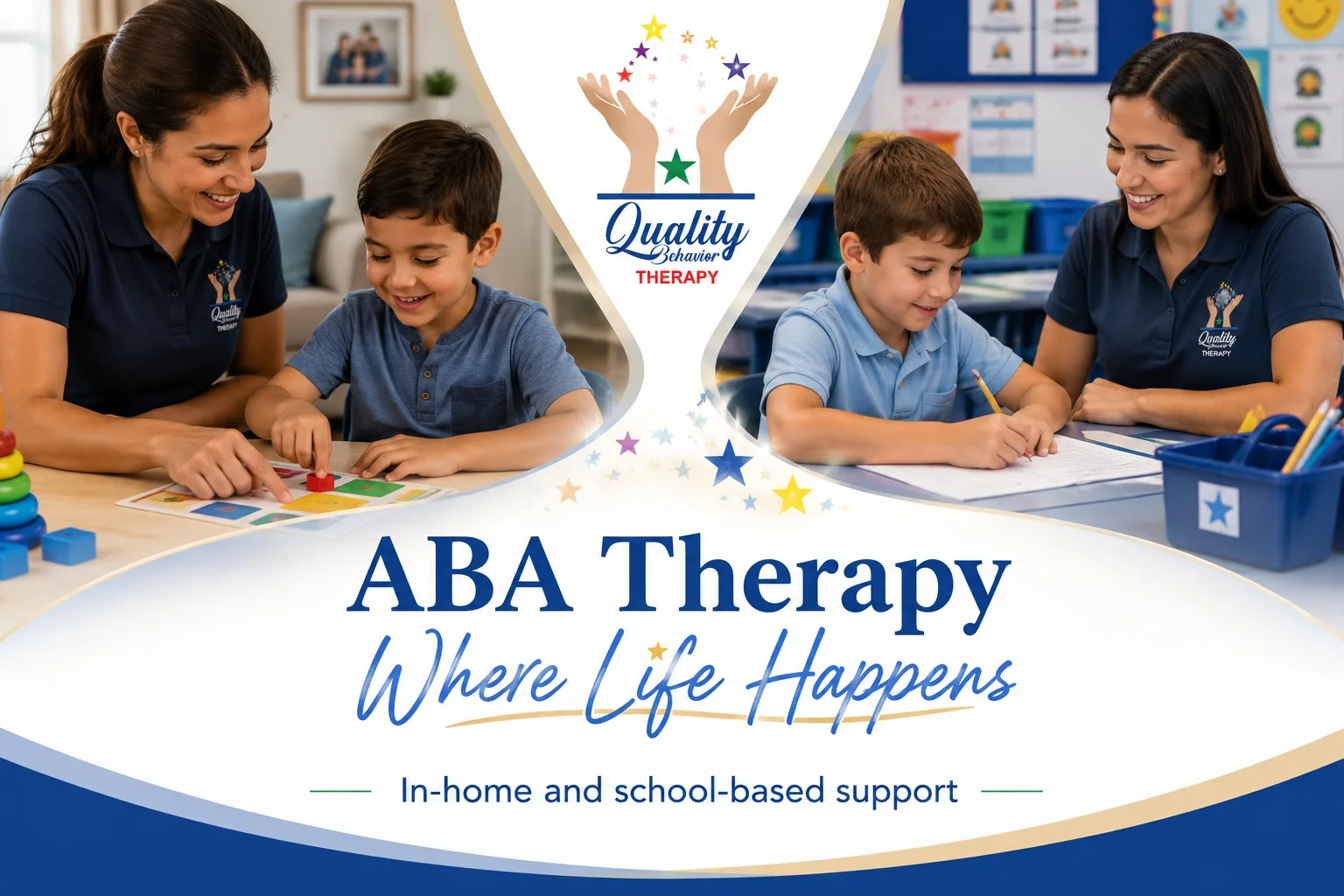
Once your child's ABA hours are approved, a question arrives that most families are not prepared for: where should the therapy actually happen?
It is treated as a logistics question. It is not. The setting changes which skills your child practises, who they practise with, and how naturally those skills transfer into daily life. Choosing on convenience alone is the most common way good therapy hours get spent on the wrong goals.
What in-home ABA is genuinely better at
A therapist working in your home is working where the behaviour actually happens.
That matters because of something called generalization — the gap between a child performing a skill in a therapy room and using it in real life. It is the single most common failure point in ABA, and teaching in the natural environment closes it.
In-home is the stronger choice when the goals are:
- Daily living skills — dressing, toileting, hygiene, brushing teeth
- Mealtimes and food selectivity, which are almost impossible to work on anywhere else
- Sleep and bedtime routines
- Sibling conflict and family interaction
- Household safety — elopement, kitchen dangers, road awareness
- Transitions between activities in the place they actually go wrong
It is also the setting where parents learn most. You are present, so coaching happens in the moment rather than in a scheduled meeting three weeks later.
What school-based ABA is genuinely better at
A therapist in the classroom is working where your child's hardest social and academic demands live.
School-based is the stronger choice when the goals are:
- Classroom behaviour — staying seated, following group instructions, raising a hand
- Peer interaction with children your child sees every day
- Following a teacher's instructions, which is a different skill from following a parent's
- Academic engagement and task persistence
- Playground and lunchroom navigation — the least structured, most socially demanding parts of the day
- Consistency with the IEP, so the school team and the therapy team are not pulling in different directions
That last point is underrated. When a behaviour plan exists in a child's IEP and the ABA team never sees the classroom, the two systems drift apart and the child gets contradictory expectations in each place.
Why many children need both
The most common effective pattern is a split: school hours for classroom and peer goals, home hours for daily living and family goals.
Your insurance authorizes a total number of hours, not a setting. So combining is usually a question of how those hours are divided rather than an extra cost. It is worth asking your BCBA directly how they would split them if logistics were not a factor — then solving the logistics second.
How to decide
Ask yourself which sentence describes your hardest week:
"Getting out of the door in the morning is a battle, dinner is a battle, and bedtime is a battle."
That is in-home work.
"The school keeps calling. He is fine with us and struggling in the classroom."
That is school-based work.
"Both."
Then it is both, and the split should be decided clinically rather than by whichever is easier to schedule.
What we do
Quality Behavior Therapy delivers ABA in the family's home and in school settings across Orlando, Kissimmee, Saint Cloud, Apopka and Winter Springs. We do not operate a center — if structured peer practice in a clinic setting is what your child most needs, we will tell you that plainly, and we are happy to talk through what to look for in one even if you do not become our client.
Every program is designed and supervised by a Board Certified Behavior Analyst, and we coordinate directly with school teams and IEP goals where therapy happens on campus.
Call (407) 810-1933 or book a free consultation. A BCBA will talk through your child's goals and tell you which setting they would recommend — including when the answer is not us.
Related: In-home ABA therapy · School-based ABA therapy · In-home vs center-based · Insurance and cost
Free consultation
Have questions about your child?
Talk to a BCBA in Central Florida. Free consultation, no commitment, insurance verified at no cost.