In-home ABA therapy.
ABA therapy delivered in your home, on your schedule. Your child learns in the environment where real life happens.
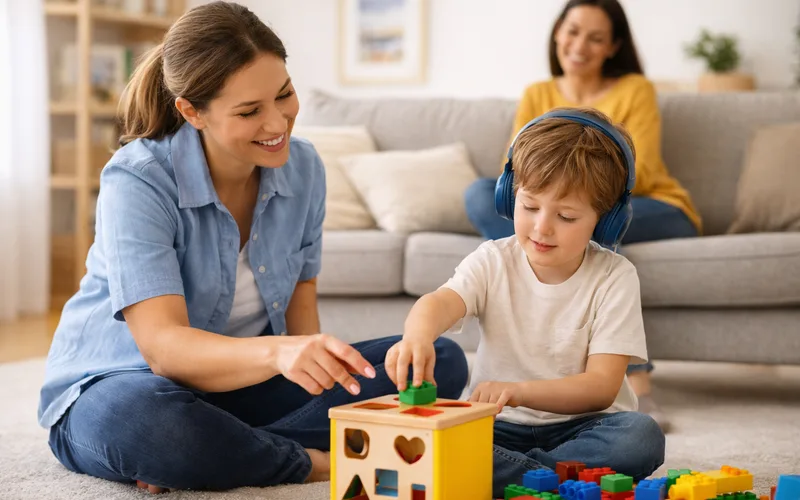
Learning where real life happens.
Research shows children generalize skills more quickly when they learn in the environment where those skills are naturally used. The home is where your child eats, sleeps, plays, and connects with family — making it ideal for many ABA goals.
A trained Registered Behavior Technician (RBT) comes to your home at scheduled times throughout the week, supervised by a BCBA who monitors progress and adjusts the program regularly.
- Morning and bedtime routines
- Mealtime behavior and feeding challenges
- Sibling and family interaction
- Household safety and independence
- Tantrum reduction and emotional regulation
What sets in-home ABA apart.
Our in-home program is built around your child's daily life — giving them tools to thrive in the environment they know best.
Familiar Environment
Children generalize skills faster when they learn where real life happens — in their own home, with their own routines.
Flexible Scheduling
Sessions are scheduled around your family's routine. Most children receive therapy 3–5 days per week at times that work for you.
BCBA-Supervised
Every program is designed and supervised by a Board Certified Behavior Analyst who monitors progress and adjusts goals regularly.
Family Involvement
Parents receive training and regular updates so they can reinforce skills throughout the day, not just during sessions.
Whole-Child Focus
We address daily living skills, emotional regulation, communication, and safety — goals that matter most at home.
Insurance Accepted
We accept Medicaid, Sunshine Health, Simply Healthcare, Molina, CMS, FCT, Aetna, and Cigna. Our team handles all verifications and authorizations.
Parents are part of every session.
In-home ABA only works when families are partners. We coach you through real strategies you can use during meals, transitions, bedtime, and the moments that matter most.
- Parents trained alongside every session
- Real-life goals woven into household routines
- Sibling dynamics and family interaction supported
- Weekly progress reviews shared transparently
What actually happens in your home.
Most families have never had a therapist in their house before and are not sure what they are agreeing to. Here is the shape of a typical visit.
Settling in
The RBT arrives at your home and gives your child a few minutes to transition. Nothing starts cold — abrupt demands are how sessions go wrong.
Teaching inside real routines
Goals are practiced where they actually occur: at the table, at the sink, during play with a sibling. Data is recorded continuously, not from memory afterwards.
Handover to you
The RBT tells you what was worked on, what went well, and the one thing to reinforce before the next visit. You should never wonder what happened in your own living room.
We come to you.
Our therapists travel from our Lake Underhill Road office across Orange and Osceola counties. If your neighborhood is not listed, call and ask — the boundary is drive time, not a fixed line on a map.
- Orlando
- Kissimmee
- Saint Cloud
- Apopka
- Winter Springs
- Winter Park
- Lake Nona
- Oviedo
- Altamonte Springs
- Ocoee
Weighing this against a center? Read our in-home vs center-based comparison →
Frequently asked questions.
Yes, a parent or authorized adult must be present during in-home sessions. We encourage family involvement as it strengthens therapy outcomes.
Session frequency depends on your child's treatment plan. Most children receive therapy 3–5 days per week. Our scheduling team will work with your availability.
We serve Orlando, Kissimmee, Saint Cloud, Apopka, Winter Springs, and surrounding communities. Contact us to confirm service in your area.
Neither setting is better in general — they are better at different things. In-home ABA is stronger for skills tied to your household: mealtimes, bedtime, hygiene, sibling conflict, and safety. A center is stronger for structured peer interaction and tolerating a classroom-like environment. Many children do best with a combination, and your BCBA will recommend a mix based on your child's goals rather than on what is convenient for us.
For a child who already has an autism diagnosis and active coverage, most families start within two to three weeks. The steps are benefits verification (2–3 business days), a BCBA assessment, and plan authorization by your insurer, which is usually the longest wait. If your child does not have a diagnosis yet, we can handle that evaluation first.
Yes. Florida Medicaid and the managed care plans serving Central Florida cover in-home ABA with a valid autism diagnosis, as do most commercial plans under Florida's autism insurance reform law. Setting does not change the benefit. We verify your exact coverage at no cost before therapy begins.
Typically 10–40 hours per week, set by your child's BCBA assessment rather than by a standard package. Younger children in early intervention are usually at the higher end; school-age children receiving therapy after school are often at the lower end. Your insurer authorizes a specific number of hours, and we tell you what that number is before you commit.
Related services.
Bring ABA into your home.
Schedule a free consultation and we'll handle the rest — from insurance verification to your first session.